


 Contents


Lukashenka is easing international isolation of the Belarusian regime but does not abandon authoritarian practices or the country’s orientation towards Russia
After more than five years of international isolation of the Belarusian regime, Lukashenka highly likely believes that the changing foreign policy landscape presents an opportunity to restore Belarus’s relations with the West to their pre-2020 state.
Although the Belarusian regime has expressed an interest in improving relations with Western countries, it almost certainly does not intend to soften its authoritarian policies. Lukashenka is maintaining his grip on power through repressive measures; therefore, in the medium term, the regime will continue to persecute opponents, critics and even individuals seeking alternative information. By releasing prominent Belarusian democratic opposition figures and other political prisoners, the Belarusian regime almost certainly was primarily hoping for a favourable response and proposals for possible negotiations from Western countries or the lifting of sanctions. Using political prisoners as a bargaining tool is an age-old tactic of the Belarusian regime, as demonstrated multiple times in the past when political prisoners were released in order to demonstrate the regime’s alleged goodwill.
The regime is seeking to restore relations or soften sanctions not only by releasing political prisoners. It is also pursuing these objectives by creating or exploiting problems that threaten the security of neighbouring countries. While we assess that the regime has the capability to prevent the smuggling of cigarettes by high-altitude balloons, it deliberately exploits this criminal activity for political gain – specifically to initiate a political dialogue with Lithuania and reduce the restrictions imposed on Belarus. As was the case in 2021, when it orchestrated an illegal migration crisis, the regime is claiming that the balloon crisis cannot be resolved due to international sanctions imposed on the country or unwillingness of Belarus’s supposedly hostile neighbours to cooperate.
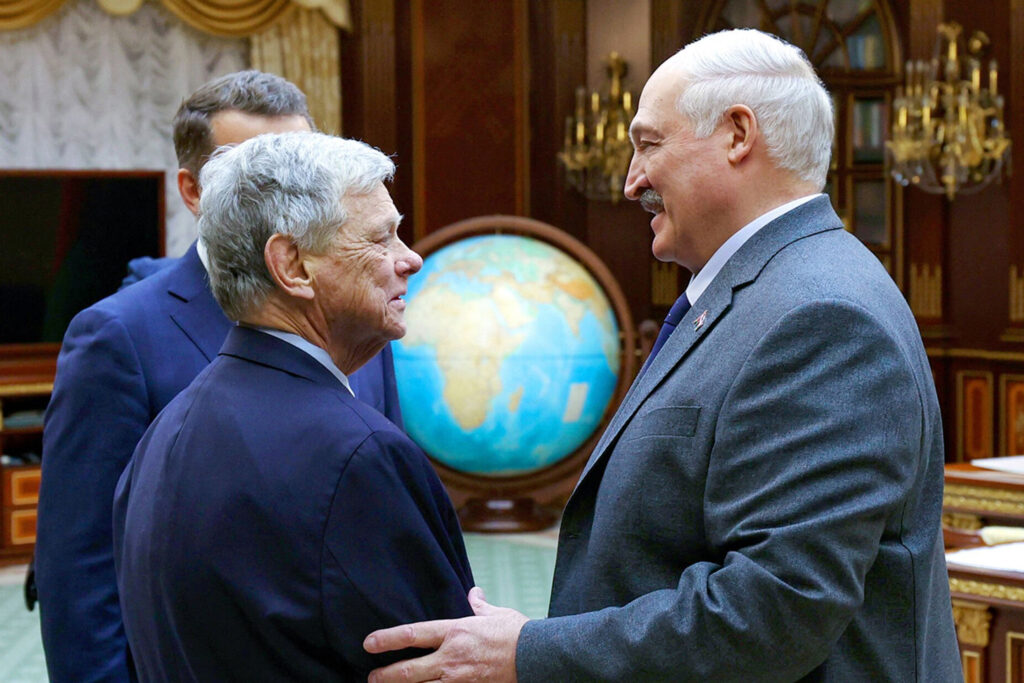
The Belarusian regime’s attempts to normalise relations with the West are motivated by political and economic interests. Proving the legitimacy of his rule is essential to Lukashenka. His public meetings with Western officials strengthen Belarusian regime’s international status and create the impression that it is no longer as isolated as it was following its crackdown on protests against rigging of the 2020 presidential election. The regime’s propaganda exploits Lukashenka’s contacts with Western representatives for both domestic and foreign policy gains, reinforcing the narrative that ensuring regional security is inseparable from Belarus’s involvement in addressing security problems in the region.
Although the regime denies the impact of Western sanctions on the Belarusian economy, the easing of the sanctions on key economic sectors is likely to have a significant impact on the country’s economic sustainability and growth. At present, Belarus’s economic stability is only ensured by continued financial support from Russia, the most significant factor contributing to the country’s dependency on Russia. While restoring economic ties with the West would partially reduce the economic pressure on Belarus, it would not constitute an alternative to its growing economic dependence on Russia.
Despite Belarus’s interest in improving relations with the West, its policies and actions towards Lithuania and neighbouring countries are highly likely to remain aggressive in the near term. While Belarus is likely to convey its desire to restore relations and cooperation with Lithuania, it will be reluctant to take concrete steps to reduce tensions. It will deny any involvement in hostile actions against Lithuania and will disseminate propaganda accusing Lithuania of aggression towards Belarus.
AFP photo


