Contents


Reduced Western pressure on Moscow would accelerate Russia’s preparations for conflict with NATO
The security situation in Lithuania and the region is directly dependent on the course of Russia’s war against Ukraine, as it determines Russia’s ability to increase its military capabilities. As long as Russia has to allocate most of its available resources to the war, its ability to pose military threats to other countries is limited. However, this may change depending on how Russia’s war will evolve.
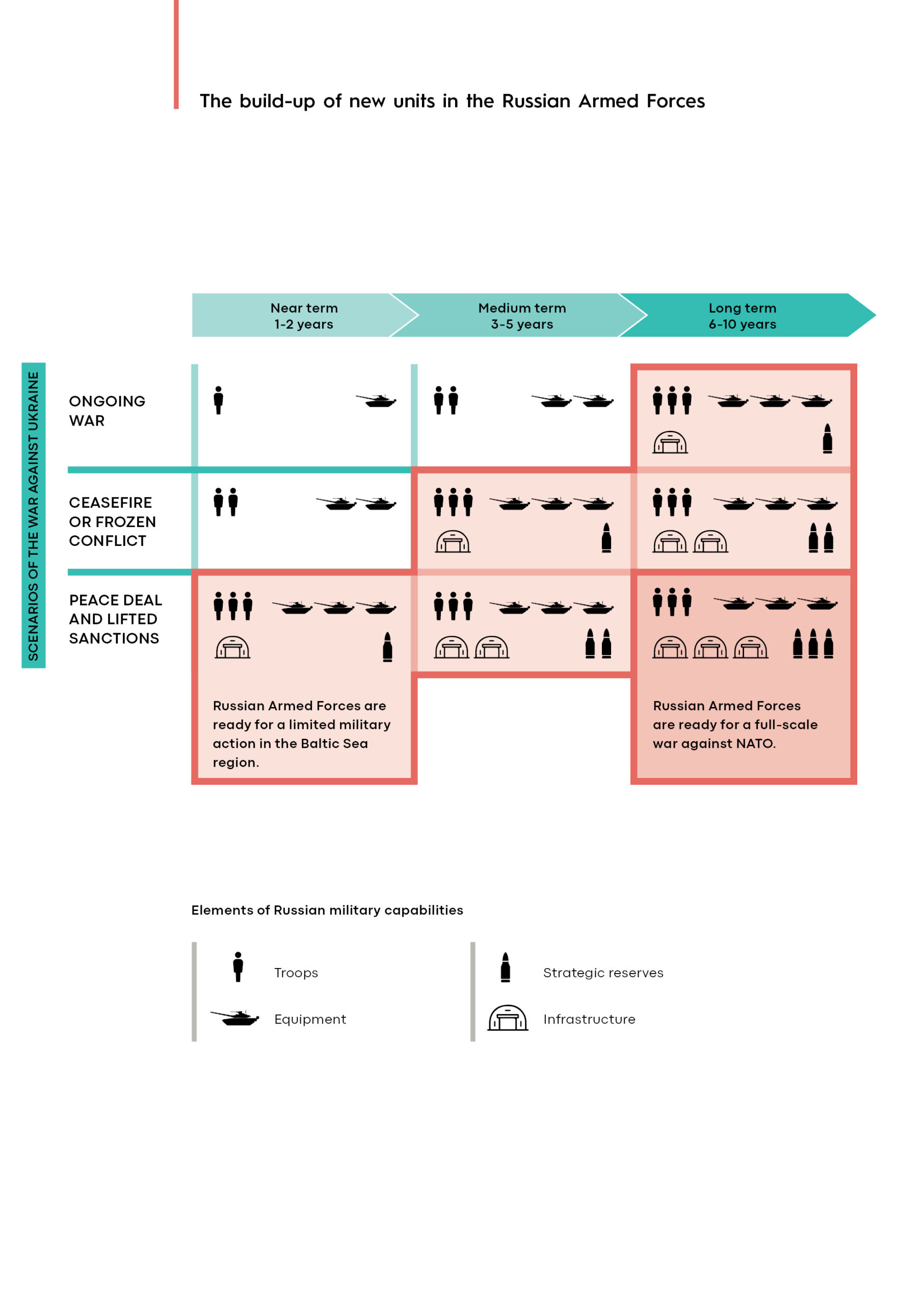
If Russia continues its military actions against Ukraine with the same intensity as in the last four years, the war will require significant human and financial resources, and Russia’s ability to pose military threats to other countries will remain limited. Even while at war, Russia is rebuilding its army and creating new military units, most of which are being sent to fight against Ukraine. In the medium term, Russia is likely to be able to assemble new military units. If the war continues in the long term, Russia will likely be able to fill the newly created military units with troops and equipment, but strategic reserves of weapons and ammunition needed for a large-scale military conflict with NATO will not be fully restored.
In case of a ceasefire or a frozen conflict, Russia would be able to develop its military capabilities and replenish its ammunition reserves more quickly. In the near term, the number of troops and equipment at permanent military bases, including units near the Baltic States, would increase. In the medium term, new units would be fully staffed and equipped, with priority given to quantity over quality. The strategic weapons and ammunition reserves depleted during the war would be gradually replenished. In the long term, Russia’s Armed Forces would not only expand in terms of quantity but also modernise. Most of the strategic weapons and ammunition reserves would be restored. Russia would be able, in this scenario, to build sufficient capabilities to launch a military action against the Baltic States and gain regional superiority at least in the initial stages of the war even without fully implementing its military reform goals. This could encourage the Kremlin to use military force based on the miscalculation and belief that NATO should be unable to respond in time, and the conflict could be localised and quickly ended in Russia’s favour, with nuclear deterrence serving as a safeguard.
If the parties sign a peace agreement and international sanctions are lifted, Russia could develop its military capabilities even faster. It could withdraw a large part of its forces from Ukraine, have greater freedom to dispose of larger financial resources and more easily obtain the technology needed for its war industry. In the short term, newly created military units, including those located near the Baltic States, would be almost fully staffed and equipped. In the medium term, strategic reserves would be rapidly restored and the military industry modernised, with an increasing focus on quality. In the long term, Russia likely would create not only a 30-50 percent larger army than it had before the war but also a relatively modern one. Strategic reserves of weapons and ammunition would be fully restored. Russia would be ready for a conventional military conflict with NATO.
Click on the image to enlarge it.